.svg)

Two packs, one partnership

Closing the Exposure Window: Turning Runtime Risk Into Adaptive WAF Protection with Upwind + Huskeys
Cloud teams can now identify vulnerabilities faster than ever before. The harder challenge begins after a vulnerability is confirmed: determining whether it represents real exposure and taking action before a permanent fix can be deployed.
Recent advances in AI-assisted security research, including Anthropic’s Mythos, highlight how quickly vulnerability discovery and analysis are evolving. As researchers can analyze complex software systems faster, security teams need better ways to understand which vulnerabilities represent real risk and reduce exposure before attackers can take advantage.
Upwind’s AI-powered security agents continuously analyze cloud environments to validate risk in real time, helping teams distinguish between vulnerabilities that simply exist and those that are actually reachable and exploitable.
Huskeys extends that intelligence into the protection layer. When Upwind confirms that a cloud vulnerability represents a real exposure, Huskeys evaluates the WAF coverage protecting the affected asset and generates targeted protection that blocks the exploit path at the edge while remediation continues.
Two packs, one partnership. Upwind validates real exposure, and Huskeys turns that insight into protection at the edge.
The Gap Between Discovery and Remediation
Identifying a vulnerability is only the beginning. The real challenge is reducing exposure while teams work toward a permanent fix.
In modern cloud environments, remediation is rarely as simple as applying an update. Applications rely on complex dependency chains, and even a targeted upgrade can require extensive testing, coordination across teams, and carefully planned deployment windows. At enterprise scale, where organizations manage hundreds or thousands of workloads across multiple cloud environments, eliminating exposure immediately can become a significant operational challenge.
CVE-2025-55182, the React Server Components vulnerability sometimes referred to as React4Shell, highlighted this challenge. Shortly after the vulnerability was disclosed, attackers began scanning for vulnerable systems and exploiting exposed environments while organizations were still working to identify affected assets, validate exposure, and deploy updates safely.
Source: NVD CVE-2025-55182
The challenge is not only knowing that a vulnerability exists. It is reducing exposure during the window between confirmation and remediation, when the risk is real but the permanent fix is still in progress.
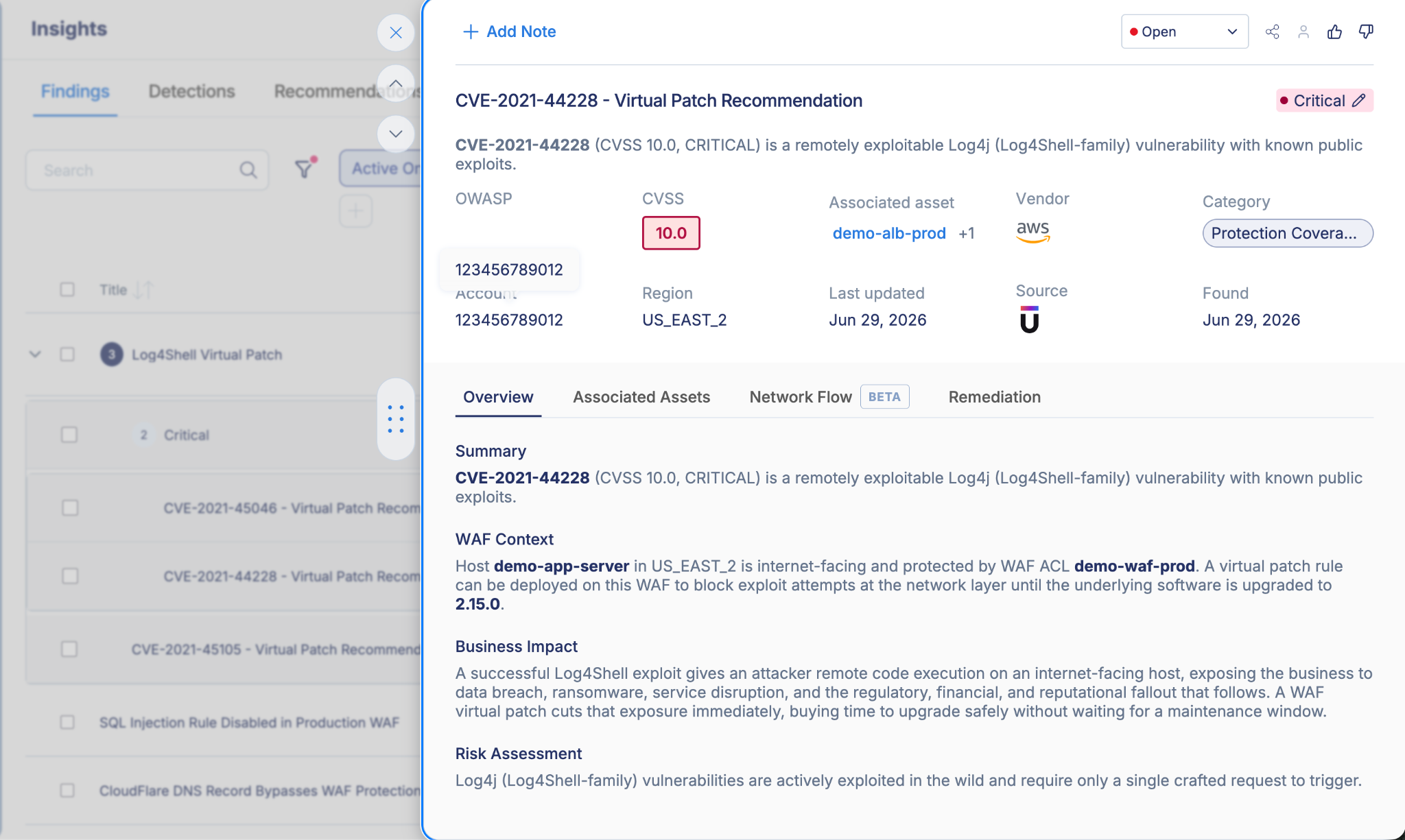
Closing the Gap Between Exposure and Remediation
Virtual patching helps close this gap by reducing exposure while teams work toward the permanent fix.
Rather than modifying the vulnerable application itself, virtual patching adds an additional security layer that blocks the specific exploitation path before it reaches the affected component.
It is not a replacement for remediation. The underlying vulnerability still needs to be addressed through the appropriate development and release process. Instead, virtual patching gives security teams the ability to reduce risk immediately without waiting for a full application update.
For cloud environments, this protection is often enforced at the WAF layer, where malicious requests can be blocked before reaching the application.
From Validated Risk to Edge Protection
The challenge in vulnerability management is not only knowing which vulnerabilities exist. It is understanding which ones represent real, exploitable risk and being able to act on them quickly.
Upwind provides the runtime context needed to identify reachable vulnerabilities and prioritize the risks that matter. Instead of treating every CVE equally, teams can focus on vulnerabilities that represent actual exposure in their environment.
Huskeys takes that validated exposure and turns it into targeted WAF rule or Network mitigation based on the actual exploit path and affected asset.
The result is a workflow that connects detection, validation, and protection. Security teams can move from understanding a vulnerability to reducing exposure without introducing changes to application code or disrupting existing remediation processes.
Zero Friction Integration
Connecting Upwind and Huskeys does not require changes to the existing security architecture.
The integration uses a read-only OAuth2 API connection from Upwind. There are no agents to deploy and no changes to the application data path.
Once connected through the Huskeys Integrations page, validated vulnerability data can flow directly into the protection workflow.
This allows teams to introduce virtual patching capabilities without adding operational complexity or changing how their applications run.
From Runtime Intelligence to Adaptive Protection
Finding an exploitable vulnerability and protecting against it are often separate workflows owned by different teams.
Security identifies the risk, engineering plans the fix, and application security or network teams determine whether temporary WAF protection is needed. During that time, applications may remain exposed while remediation moves through testing and deployment.
Runtime context helps teams focus on the vulnerabilities that matter.
For example, a vulnerable library may exist across multiple workloads, but only one service may expose the affected functionality to the Internet. Upwind validates whether vulnerable code is loaded, whether the affected functionality is reachable, and whether the workload is actively serving traffic.
Once exposure is validated, Huskeys generates adaptive protection at the WAF and Network layers for the specific application and exploit path.
Instead of manually analyzing findings, creating custom rules, testing them, and deploying them during an active incident, teams can reduce the attack surface while engineering continues working on the permanent fix.
The result is a streamlined workflow that connects validated runtime intelligence directly to adaptive edge protection, reducing the exposure window without disrupting existing development or remediation processes.
Closing the Exposure Window
A vulnerability does not become less risky simply because a fix is planned. Until remediation is complete, organizations remain exposed during the critical window between identifying a vulnerability and deploying a permanent solution.
By combining runtime intelligence and context with adaptive edge protection, Upwind and Huskeys enable security teams to understand which vulnerabilities represent real risk and reduce exposure before a full remediation can take place.
Validated cloud exposures can be translated into targeted virtual patching at the WAF layer, blocking active exploit paths while engineering teams continue working on the underlying fix.
Together, Upwind and Huskeys help close the gap between vulnerability discovery and remediation, giving security teams a practical way to reduce risk during the period when attackers are most likely to exploit newly discovered vulnerabilities.
About Huskeys
Huskeys provides an AI-powered control plane for edge security that sits on top of existing WAF and CDN infrastructure. Huskeys helps organizations continuously assess effectiveness, optimize protection, reduce cost, and orchestrate operations at scale without replacing existing WAF or disrupting production.
Got WAF?
We Make It Work.
Book a Demo. 🐕


